If you have been asking yourself why won't my dog go up the stairs all of a sudden, you are not overreacting. A sudden change in your dog's willingness or ability to navigate stairs is one of the clearest signals that something is physically wrong. Dogs are naturally stoic and rarely show obvious pain until discomfort has become significant enough to affect movement. Stair avoidance is often one of the first visible clues that something is going on in the spine, joints, or nervous system.
Common Reasons Dogs Suddenly Avoid Stairs
When a dog that previously had no trouble with stairs suddenly refuses or hesitates, the cause is almost always physical rather than behavioral.
Some of the most common culprits include:
- Spinal subluxations that create pressure on the nerves controlling the hindquarters
- Intervertebral disc issues, ranging from mild irritation to significant compression
- Hip dysplasia or early arthritis, particularly in larger or older breeds
- Muscle soreness or strain from overexertion or injury
- Joint inflammation in the rear legs that makes the upward push painful
In many of these cases the dog has no visible injury and may seem fine at ground level. Stairs simply require a range of motion or force that aggravates the underlying problem.
Why Won't My Dog Go Up the Stairs All of a Sudden? It Could Be Spinal
The spine is often overlooked as a root cause of stair avoidance, but spinal health directly governs how well the entire body functions. When vertebrae become misaligned, they create interference in the nervous system that affects muscle coordination, strength, and the ability to generate controlled movement.
A dog with a spinal subluxation may appear to walk normally on flat ground but struggle or refuse when asked to climb. The additional load on the rear legs during stair climbing amplifies what might otherwise be a subtle problem.
According to the American Veterinary Chiropractic Association, spinal dysfunction in dogs is a recognized contributor to mobility problems, gait abnormalities, and reluctance to perform movements that require coordinated hindquarter engagement.
What to Watch for Beyond Stair Avoidance
If your dog is avoiding stairs, pay attention to whether any of these related signs are also present:
- Reluctance to jump onto furniture or into a car
- A change in gait, such as crossing the rear legs or swaying
- Sensitivity when touched along the back or near the hips
- Sitting or lying down more than usual
- Crying out when picked up or when getting up from rest
Any combination of these signs alongside stair avoidance warrants a professional evaluation.
How Animal Chiropractic Can Help
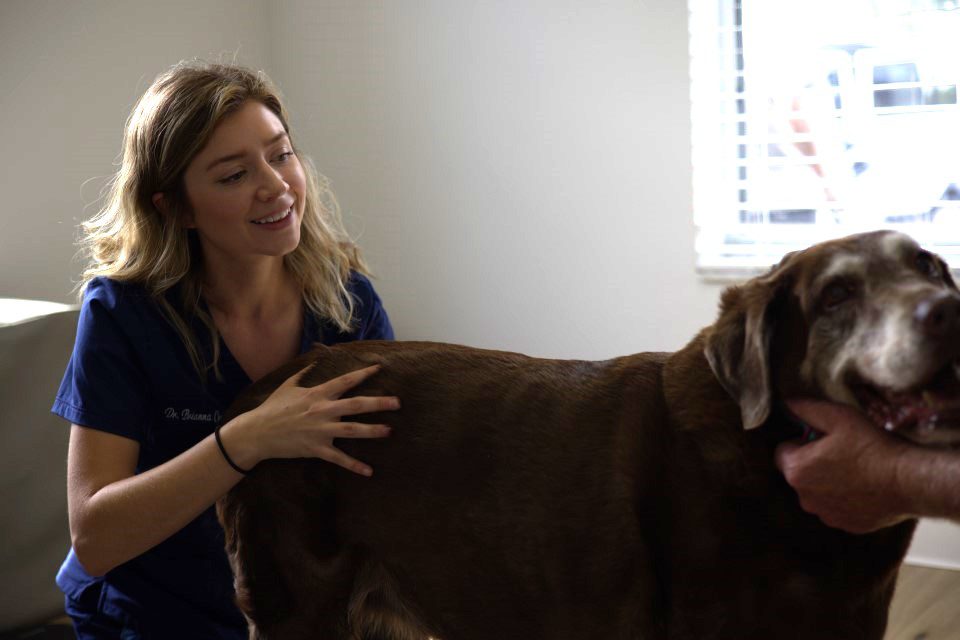
Animal chiropractic focuses on identifying and correcting misalignments in the spine and joints that interfere with normal nervous system function. When those misalignments are corrected, the body can communicate more efficiently, muscles coordinate properly, and movement becomes less painful.
At Trilogy Chiropractic, Drs. Paul and Brianna Cundiff and Dr. Mickey Frazetta are certified in animal chiropractic and take a specific approach to assess and correct dogs with precision. Many patients see meaningful improvement in mobility after just a few sessions.
Our animal chiropractic page explains the full approach and what to expect during your pet's first visit.
Wondering why won't my dog go up the stairs all of a sudden? Our dog chiropractic care is designed to find the root cause and correct it rather than simply manage symptoms.
Schedule a Visit for Your Dog
Why won't my dog go up the stairs all of a sudden? The answer often lies in the spine, and the sooner it is addressed the sooner your dog can move freely and comfortably again.
Contact us today to book a visit for your dog at our Bradenton location and find out how animal chiropractic care can restore their quality of life.